
Kapolei City Directory Shelf
Kapolei city directory research begins with Honolulu and island-wide publications. The modern community formed after much of the verified print run, so the absence of a Kapolei heading is expected. The UH Mānoa Hawaiʻi genealogy guide identifies the main publisher families and runs. FamilySearch supplies catalog and film details, while the Library of Congress provides a digitized telephone book. These collections overlap, but they are not interchangeable.
| Collection | Years | Where Held | Access |
|---|---|---|---|
| McKenney’s Hawaiian Directory | 1884–1885 | UH guide and FamilySearch | Catalog and microfilm |
| Husted and related handbooks | 1888–1910 | UH and FamilySearch | Issue-specific film access |
| Polk-Husted Honolulu city/county | 1911–1941/42 | UH guide | Microfilm and library research |
| Polk’s Honolulu | 1947/48 onward | UH guide | Verify the exact shelf run |
| Honolulu White and Yellow Pages | 1952–1953 | Library of Congress | Free text, PDF, and images |
A catalog entry proves that an item was described, not that every image is free from home. Some FamilySearch images require an account or a FamilySearch Center. For later Polk volumes, the accessible guide confirms the run begins in 1947/48 but does not verify a last year. Ask the holding library about the exact issue before traveling.
Kapolei Directory Publishers by Era
The publisher name is part of the evidence. McKenney’s 1884–85 book includes Honolulu within a Kingdom-wide directory. Husted titles shift from Honolulu and the Hawaiian Islands to Honolulu and the Territory of Hawaii. Polk-Husted then carries the City and County and territorial wording through 1940/41, followed by a Polk issue around 1941/42 and a postwar run beginning in 1947/48.
| 1884–1885 | McKenney’s Hawaiian Directory |
|---|---|
| 1896–1910 | Husted directory families |
| 1911–1941/42 | Polk-Husted and Polk Honolulu runs |
| 1947/48 onward | Postwar Polk run, terminal year not verified |
| 1952–1953 | Digitized Honolulu telephone directory |
The UH Hawaiʻi genealogy guide is the documented source for this publisher sequence and the associated film notes.
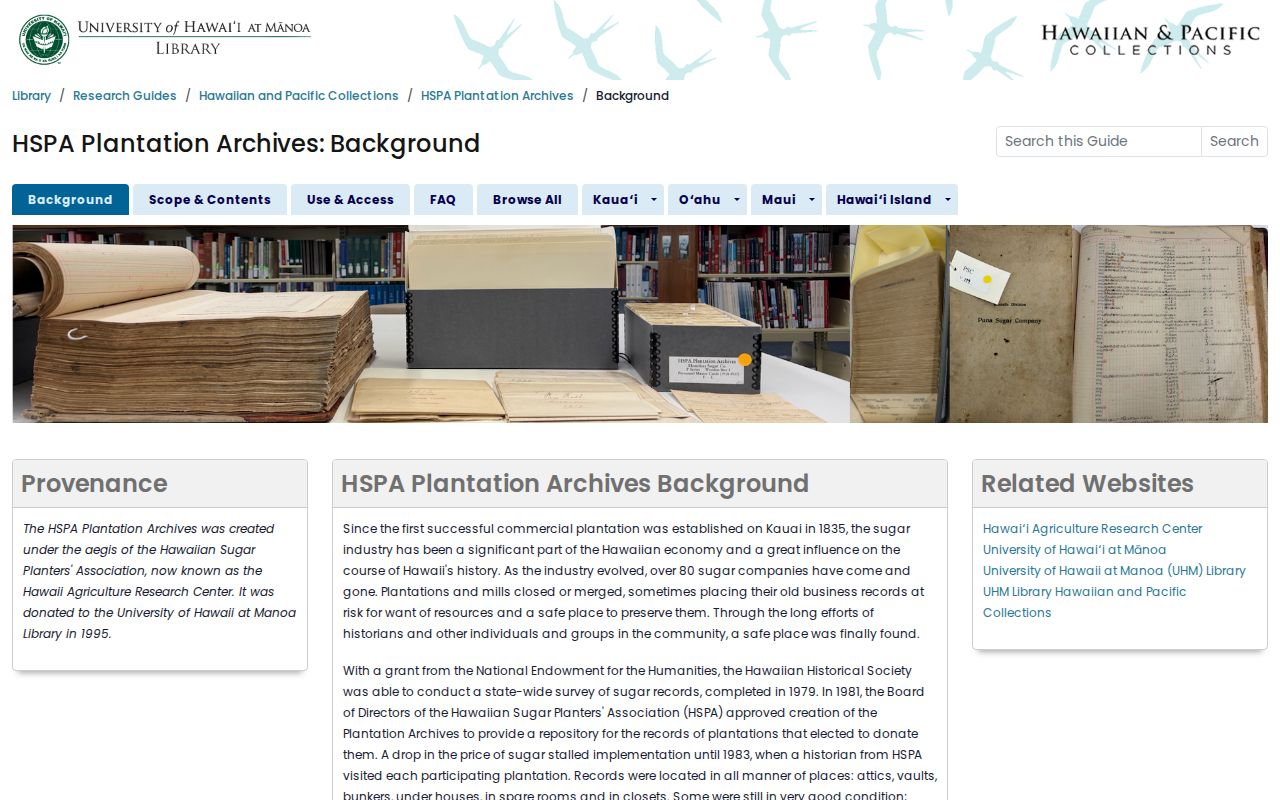
The captured guide grounds the dates in a library research source. Check its title lines and holdings notes rather than treating all editions as one continuous series.
Record the full title, publisher, year, page, and printed place label. That detail separates a missing issue from a missing person and keeps two similar entries from being merged. It also makes a later archive or library request precise.
Kapolei Names Under Older Headings
A present-day Kapolei address may have no literal match in a nineteenth-century or early twentieth-century city directory. Search Honolulu, Ewa, Waipahu, Barbers Point, ʻEwa Plain, and Oʻahu as place terms. Publication geography follows the publisher’s world, not today’s Census-designated place or postal label. Keep the source spelling, including ʻokina and other marks, then test a plain-keyboard version only as a search aid.
Search tip. Preserve the printed place heading and the modern label side by side; do not silently rewrite an Ewa or Honolulu entry as Kapolei.
This mismatch is a useful finding. It explains why a surname can appear in regional material while a modern street does not. It does not prove that every Honolulu listing belonged to west Oʻahu. Pair the printed entry with a deed, census schedule, archive index, or newspaper item that supplies a second date and place.
Reading a Kapolei Directory Entry
The 1952–1953 Honolulu telephone directory shows the compact structure of an actual listing. The searchable item contains 499 images plus text and PDF derivatives. Lines place the surname first, followed by a given name or initials, an address, and sometimes a telephone number. Titles or credentials can appear. A repeated r occurs before many residential addresses, but the captured source did not expose a firm abbreviation key, so it should remain an unresolved mark.
| Identity | Surname, given name, or initials exactly as printed |
|---|---|
| Title | Mrs., rank, credential, or another printed label |
| Address | Street number and name, or a community name |
| Telephone | Exchange and number when the subscriber was listed |
| Issue date | The publication period that dates the evidence |
- Criss-cross directory
- An address-first directory arranged by street rather than by surname. No exact Honolulu title and year run was verified in the accessible official sources.
- Householder index
- A name or address list identifying the person shown as the primary listing, not necessarily every person in a home.
- Abbreviation key
- The publisher’s own legend for shortened words and symbols. Copy it before interpreting marks in an entry.
The digitized view is worth opening beside its text. OCR can drop punctuation, split Hawaiian names, or mistake letters for numbers. The image preserves the printed column and nearby entries, while the issue date stops an old telephone line from being treated as current resident evidence.
Trace Kapolei Families Across Years
City directories help fill the years between released federal census schedules. Hawaiʻi’s first federal census was in 1900, and federal schedules through 1950 are public under the 72-year rule. A directory may place a name at an address between those census years, while a deed, probate reference, or newspaper notice can explain a move or change in the listing.
- Find the earliest likely surname entry and copy its year, publisher, page, address, and all printed notation.
- Check the next available issue. Note gaps in the collection instead of assuming the book was annual.
- Search each address and spelling variant, then compare the result with the nearest released census year.
- Use a probate, will, marriage, or newspaper index to test a change that the publication alone cannot explain.
- Save the call number, film or DGS identifier, and image number so another reader can reproduce the match.
Disappearance has several possible causes. A person may have moved, died, changed a surname, used initials, or stopped publishing a telephone number. It is not enough to pick one. The Kapolei resident lookup can help check a later name in modern official indexes without changing the meaning of the historic entry.
Kapolei City Directories on Film
FamilySearch catalog record 620394 describes 18 reels of Honolulu city directories. Visible items include McKenney for 1884, Lane for 1890, Husted for 1892 and 1898, and Husted issues from 1900–01 through 1907. The 1884 item is film 2156544, item 1, with DGS 9177492. Later issues occupy film 2156545 and films 1759763–1759764.
Search the catalog by place, keywords, title, author, subject, surname, call number, or film and image-group number. The availability filter can narrow online material. Restrictions may still send a reader to a FamilySearch Center. Write down both the film number and item number because several books can share one reel.
These reels support the early publisher timeline. They do not establish a complete Kapolei shelf or an address-first criss-cross series. That gap should stay visible until a library catalog or reference librarian confirms a specific title and run.
Kapolei Directory Research Rooms
The nearest first stop is the Kapolei Public Library at 1020 Manawai Street, 808-693-7050. Its branch page lists computers, Wi-Fi, newspapers, magazines, and copying. Use the reference desk for catalog help and referrals, but do not assume the branch holds the full Honolulu run.
Campbell Library
UH West Oʻahu, 91-1001 Farrington Highway
808-689-2703 research help
Public in-building use is documented.
Hawaiʻi State Archives
364 South King Street
Reading room Monday through Friday, 9 a.m. to 4 p.m.
Indexes, maps, directories, and finding aids.
Historical Society
560 Kawaiahaʻo Street
808-537-6271
Reading room by appointment; materials do not circulate.
The James & Abigail Campbell Library offers OneSearch, research help, and in-building public use, although a dedicated Honolulu directory run was not verified there. The Hawaiʻi State Archives supplies historical indexes and a reading room. Each access channel solves a different problem: the local desk routes the question, the university catalog identifies sources, and the archive connects names to government reference numbers.
Archive Indexes Extend Kapolei Directories
A printed directory entry becomes stronger when an archive index supplies a date or case reference. Hawaiʻi State Archives lists marriage indexes for 1826–1929, divorce indexes for 1848–1929, probate indexes for 1848–1915, and will indexes for 1852–1915. Naturalization, denization, and passport indexes cover additional nineteenth-century spans. These are finding tools, not promises that the whole case file is online.
January 2026 digitization news from the Archives described indexes to hundreds of thousands of records, including 64 index volumes. The gain is discoverability. An online name and reference number may still lead to a reading-room or written request for the underlying file.
Copy the exact index title, date range, reference number, and name form. Then compare them with the publisher and address from the city directories. This keeps two people with the same initials apart and makes the request narrow enough for staff to answer.
Kapolei History Beyond City Directories
The Hawaiian Historical Society research collection bridges gaps with more than 12,000 books and pamphlets, about 35 linear feet of manuscripts, newspapers, maps, photographs, broadsides, and journals. Its reading room is appointment-based, and materials do not circulate. The online catalog offers a starting point, but staff contact may be needed when a title is described under regional rather than Kapolei terms.
The historical collection is shown below from the same official research page. Its catalog and appointment rules matter as much as the image because they determine how a reader reaches the underlying item.

The page confirms a deep Hawaiʻi and Pacific collection, not a guaranteed Kapolei-only volume. Use its maps and newspapers to test a name, organization, or older place label found in a directory.
Limits of Kapolei City Directories
Printed books omit people. Some households lacked a telephone, declined publication, used a business name, or appeared only under initials. Directory dates can also lag a move. A street address in one issue is evidence for that publication period, not a complete family roster and not proof of current residence.
No Kapolei-titled Sanborn map was found in the official Library of Congress holdings inspected. Waipahu’s seven sheets from 1953–1957 provide west Oʻahu context only. Likewise, an exact Honolulu or Oʻahu reverse-directory title and year run was not verified. Modern address-keyed ownership belongs in the Kapolei street directory; the historical shelf should not be stretched into a present-day parcel list.
Note: Photograph the title page and abbreviation key before copying entries, since both establish the issue date, publisher, and meaning of its symbols.