
Finding Kapolei Resident Records
A useful Kapolei residents directory search begins with the record that matches the known fact. A street address points first to Honolulu's parcel map and Real Property Assessment Division, or RPAD. A name can be checked in the Bureau of Conveyances deed index, eCourt Kōkua, or a state license record. An older name belongs in the Honolulu and Oʻahu directory collections held by libraries and archives. Each source assigns a role to the person it names. That role may be owner, grantor, court party, licensee, voter, or historical directory listing.
No official source gives a live list of every person in a home. A parcel card names the assessed owner, not all occupants. The public voter service is a first-party tool, not a street roster. Directory entries reflect their issue date. A strong match therefore uses a second record and compares dates, name variants, the street or TMK, and the person's role.
- Enter the complete address in the Honolulu property search, or use the parcel map to find its TMK.
- Save the owner name, site address, mailing address, assessment year, and document clues exactly as shown.
- Search the Bureau of Conveyances index by TMK, recorded name, or document number.
- For one named person, compare a second independent source such as eCourt Kōkua or an official license record.
- Move older searches to the directory shelf, archives, or the custodian's written request channel.
Kapolei Directory Record Keepers
Kapolei is a census-designated place, not a separately incorporated city with its own recorder. Land records run through the statewide Bureau of Conveyances. Property assessments and local elections belong to the City and County of Honolulu. Court files for Kapolei are part of Hawaiʻi's First Circuit, with public terminals at the Kapolei Judiciary Complex. Knowing that split prevents a common dead end: asking the Honolulu City Clerk for deeds or asking a Kapolei municipal office for birth certificates. The detailed address route appears in the Kapolei street directory.
Start at the local Kapolei RPAD office when the question concerns a parcel card or assessment. Use Honolulu Elections for a registration service or restricted voter-file request. Move to BOC for title instruments and to the Judiciary for case files. Each office confirms only the record it keeps.
Hawaiʻi Bureau of Conveyances
1151 Punchbowl Street, Room 120
Honolulu, HI 96813
808-587-0147
Honolulu RPAD, Kapolei
1000 Uluʻōhiʻa Street, Suite 206
Kapolei, HI 96707
808-768-3799
Honolulu Elections Division
530 South King Street, Room 100
Honolulu, HI 96813
808-768-3800
Kapolei Address Records to TMK
Oʻahu's tax map key, or TMK, is the stable parcel key behind many Kapolei resident records. A modern address may use a hyphenated 91- or 92- number. Keep that prefix, any zeroes, the street type, and the unit. Honolulu's GIS can turn the full address into a parcel polygon and TMK. RPAD then supplies the assessed owner, site address, mailing address, land and building facts, assessment history, and sales information where present.
The site address is the physical parcel. The mailing address is where tax notices go, and it can be elsewhere. Do not treat a remote mailing address as proof that the owner moved, or a matching address as proof that every named person lives there. The official Oʻahu parcel layer also exposes fields such as TMK, site address, mailing address, ZIP, owner, and a link back to qPublic. Its polygon is a visual reference, not a legal survey.
- TMK
- The tax map key that identifies an Oʻahu parcel.
- Situs address
- The physical site address shown for the parcel.
- Mailing address
- The tax correspondence address, which may not be the parcel.
- Parcel
- A mapped unit of land tied to assessment and title records.
Note: Preserve the full hyphenated address before comparing a Kapolei residents directory result with a parcel or deed.
Kapolei Deed Records Run Statewide
The Bureau of Conveyances, or BOC, is Hawaiʻi's statewide recorder. Its Document Search & Ordering system supports name, document number, TMK, and legal-description routes. A grantor is the party transferring an interest. A grantee receives it. Those roles make the index valuable for confirming a current owner and then walking backward through sellers and earlier buyers.
Online document access begins in January 1976. Search is free, while images and certified copies have stated charges. For an older chain, use the BOC Public Reference Room or send the written search form with the names, date range, document facts, certification request, return method, and payment. An empty online result does not prove that no deed exists. It may mark the online cutoff, a spelling variant, or a document indexed under a legal description.
The manifest could not capture the BOC portal itself, so no failed screenshot is used. The official general-public research instructions remain the best source for counter hours, written requests, and Property Watch. Property Watch can alert on later documents indexed to a name, but it does not build a chain of title.
Kapolei Parcel Search Screen
The RPAD entry page is the practical front door for a current address. It documents location-address and parcel-number searches. Results can show the parcel number, owner name, address, and a map link. The accessible guide did not verify a public owner-name input, so begin with an address or TMK instead of promising a name-only property search.
See the official Honolulu property-search entry before reviewing the captured interface.
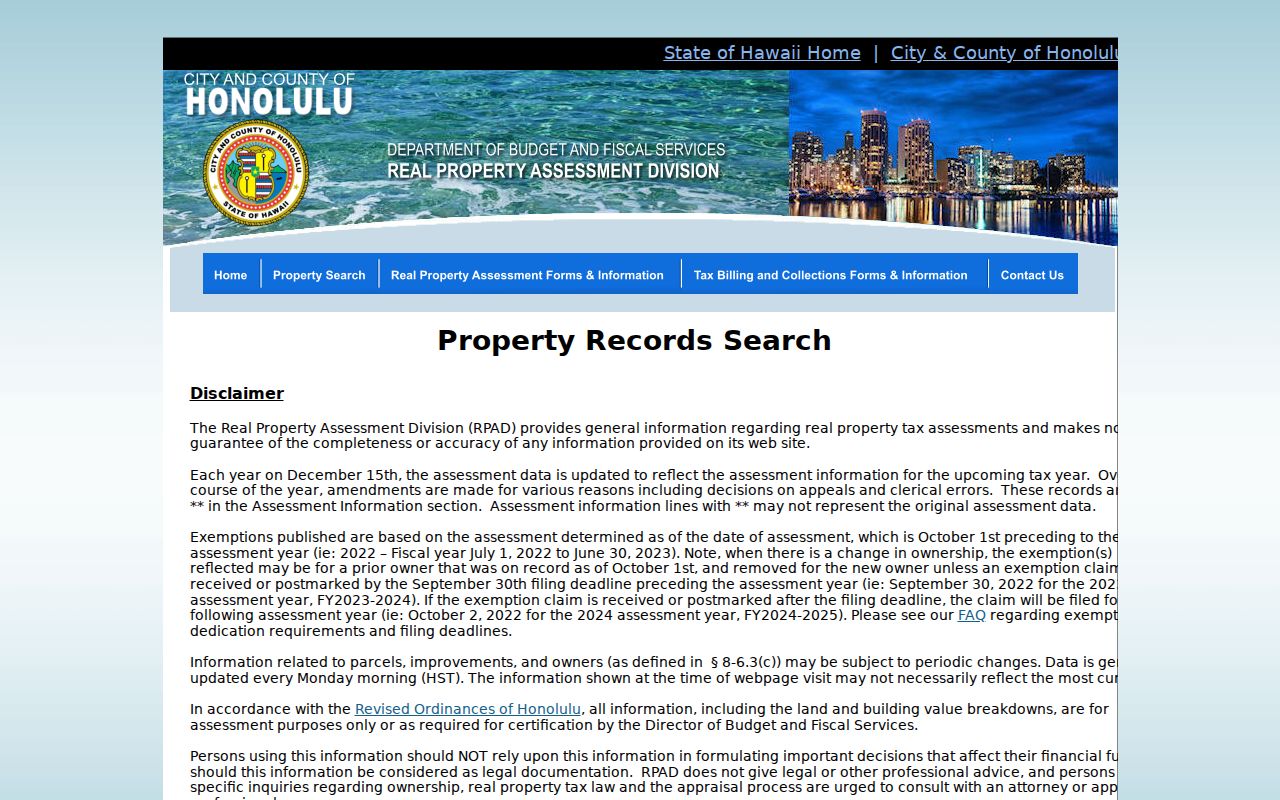
The screen connects the residents directory workflow to the county assessor, but the parcel result still needs a deed or another dated source before a name is treated as a confirmed match.
Current Kapolei Directory Sources
Modern Kapolei residents directory work uses several narrow official indexes. Each answers a different question, and none is a master household list. Start with the source that assigns the role you need. Then compare another dated record before deciding that two name hits refer to one person.
| Source | Who It Lists | Keeper | Access |
|---|---|---|---|
| RPAD parcel card | Assessed owners | Honolulu RPAD | Free online or office request |
| OLVR verification | The registrant's own record | Hawaiʻi Office of Elections | Identity-gated self-check |
| BOC document index | Grantors, grantees, and instrument parties | Hawaiʻi DLNR | Free search, paid copies |
| eCourt Kōkua | Public case parties and dockets | Hawaiʻi Judiciary | Index free, some document fees |
| MyPVL | State licensees and license status | Hawaiʻi DCCA | Free public information |
RPAD is strongest for an address-to-owner link. BOC confirms a recorded property role. eCourt identifies a party in a case, while MyPVL can confirm a license ID, legal license name, status, dates, former names, or discipline when shown. Hawaiʻi Business Express can supply an entity lead, but its live form was blocked during research, so exact fields should be checked on the current official screen. Filing and license addresses do not prove a home address. The focused one-person method is covered in the Kapolei resident lookup.
Kapolei Court Name Checks
eCourt Kōkua covers Hawaiʻi state trial, traffic, family, Land Court, Tax Appeal, and appellate case information subject to case type, age, and privacy rules. A search may use a person's name, company, party details, case ID, date, vehicle identification number, or plate in the relevant menu. Results can include a case ID, title, court, case type, party role, filing date, status, events, docket entries, and available documents.
Kapolei cases fall within the First Circuit. When a PDF is unavailable, public terminals and the counter at the Kapolei Judiciary Complex, 4675 Kapolei Parkway, provide a local fallback. Older files may require the Honolulu court branch or an offsite request. The exact case ID, party name, event, filing date, copy type, and delivery method make a request more precise.
Review the Judiciary's availability page for current coverage and fees.
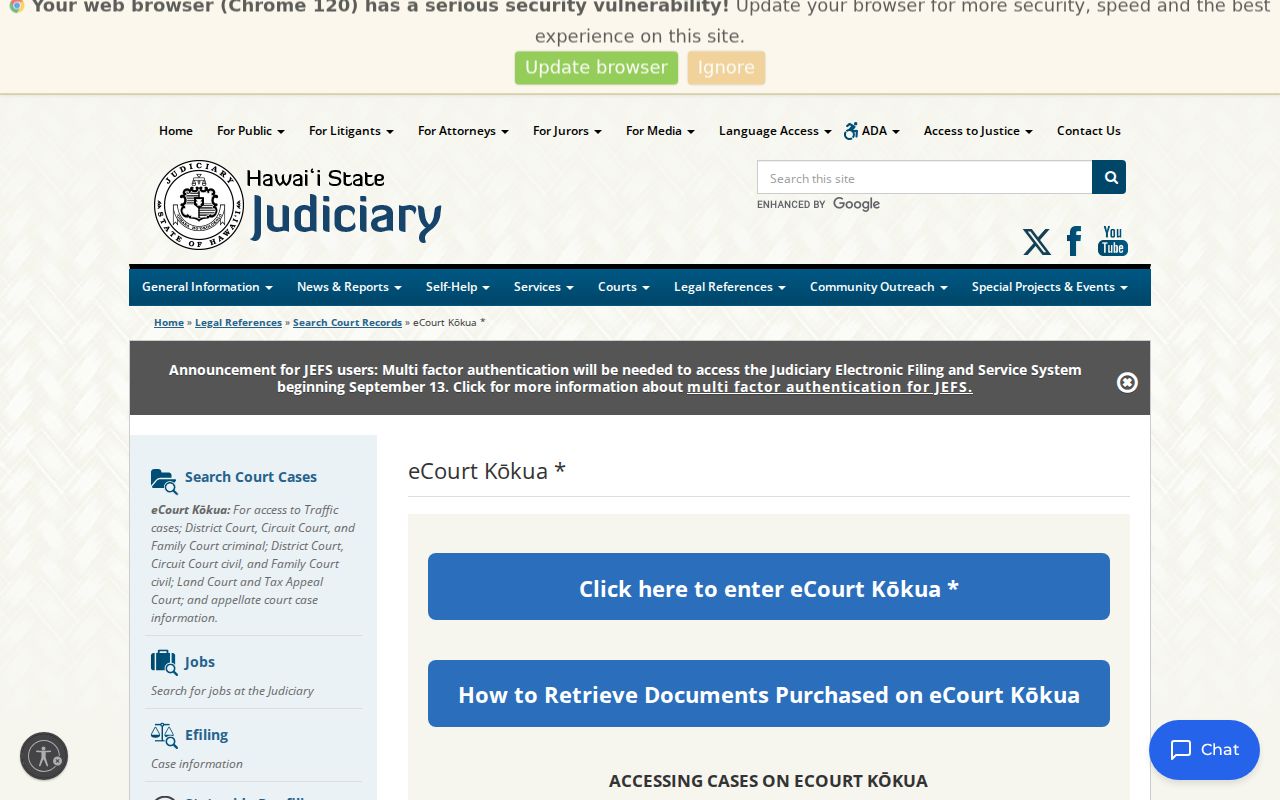
The captured page helps set expectations for online case access. Sealed, confidential, and juvenile material stays outside the public residents directory trail.
Kapolei Voter Record Limits
Hawaiʻi's Online Voter Registration system lets a registrant register, update, or confirm a registration address. The form asks for the person's first and last name, date of birth, last four Social Security number digits, Hawaiʻi driver license or state ID number, and a CAPTCHA. That design is a useful boundary. It is not a public form for entering someone else's name and retrieving a household.
HRS §11-97 makes the voter's full name, district or precinct designation, and voter status public. Other registration-affidavit information remains confidential except for election or government purposes. A full voter-file request goes through Honolulu Elections for an election-related purpose and carries use limits. Hawaiʻi does not register voters by party, and ballot choices are never part of the registration record.
Kapolei Vital Record Boundaries
Birth, death, marriage, and civil-union certificates come from the Hawaiʻi Department of Health, not a Kapolei municipal clerk. HRS §338-18 requires a direct and tangible interest for certified copies. Eligible applicants use the online, mail, or Oʻahu counter route with identification, payment, relationship information, event details, and a return address. DOH does not offer a free preliminary search simply to see whether a certificate exists.
Genealogy rules require care. The statute permits genealogy access for events more than 115 years old, while the DOH genealogy page also describes a mail route for events prior to 1921. Those statements do not align perfectly. Preserve both and confirm the cutoff with DOH before ordering. Selected birth indexes from 1896 through 1909 are available at named libraries, but an index hit is only a lead.
A timely change affects divorce research. Effective February 1, 2026, DOH stopped maintaining divorce records. Request the decree or file from the court that granted the divorce. For an Oʻahu case, begin with the First Circuit and eCourt Kōkua, then use the court counter if the document is not online.
Historical Kapolei Directory Trail
Older Kapolei residents directory searches rarely begin under a neat Kapolei heading. The verified collection spine is Honolulu, Kingdom, Territory, and City and County material. Test Ewa, Waipahu, Barbers Point, ʻEwa Plain, and Oʻahu place terms as well as Kapolei. UH Mānoa's genealogy guide identifies McKenney's directories in 1884 and 1885, Husted runs into the early twentieth century, Polk-Husted volumes through 1941/42, and Polk material from 1947/48 onward. Exact issue gaps matter.
The Library of Congress has a digitized Honolulu White and Yellow Pages item from July 1952 through April 1953 with 499 images. A typical entry may show surname, given name or initials, title, address, and telephone number. The OCR often prints an r
before a residential-looking address, but the inspected front matter did not supply a firm abbreviation key. Record the mark without defining it as fact.
Kapolei Public Library is the nearest public reference point, with computers, Wi-Fi, newspapers, magazines, and copying. UH West Oʻahu's Campbell Library provides OneSearch and research help. The Hawaiʻi State Library, UH Mānoa Hawaiian Collection, State Archives, FamilySearch catalog, and Hawaiian Historical Society carry the deeper historical trail. The full shelf-by-shelf treatment appears in the Kapolei city directory collections.
Kapolei ZIP Is Not One Map
Kapolei's primary ZIP, census place, parcel geography, neighborhood-board area, and postal city label are related but not equal. The 2020 Kapolei CDP population was 21,411. A separate official table gave a 46,928 population context for the broader 96707 ZIP area in 2015 through 2019. The larger figure is not a count of Kapolei CDP residents. It demonstrates why a ZIP-based directory must label its geography.
USPS is the final source for a delivery ZIP. Enter the company line if needed, complete street and unit, city, state, and any known ZIP. Preserve the standardized address returned. GIS may carry a ZIP attribute, but it describes parcel data and can lag postal routing. Census ZCTAs are statistical approximations. Postal references to 96709 or 96797 and nearby Ewa 96706 should be verified address by address instead of being folded into Kapolei.
Kapolei Civic Directory Layer
Neighborhood Board 34 supplies a civic record layer for Makakilo, Kapolei, and Honokai Hale. Its official page publishes agendas, minutes, resolutions, members, testimony routes, and meeting details. Those records can place a named person in a dated public role. They do not prove that each participant lives at the meeting site or within every part of the board area.
DCCA's condominium resources add registered association contacts. Research found names such as Awakea at Mehana, Anuhea at Makakilo, Nohona II and III at Kapolei, and Watercolors at Makakilo. An AOUO is an association of unit owners. Its listed president or management contact is a filing role, not a roster of neighbors. DCCA also warns that the contact list may not be complete or current, and ordinary homeowner associations are not always covered by this registry.
View the official Board 34 record page before using the captured civic source.
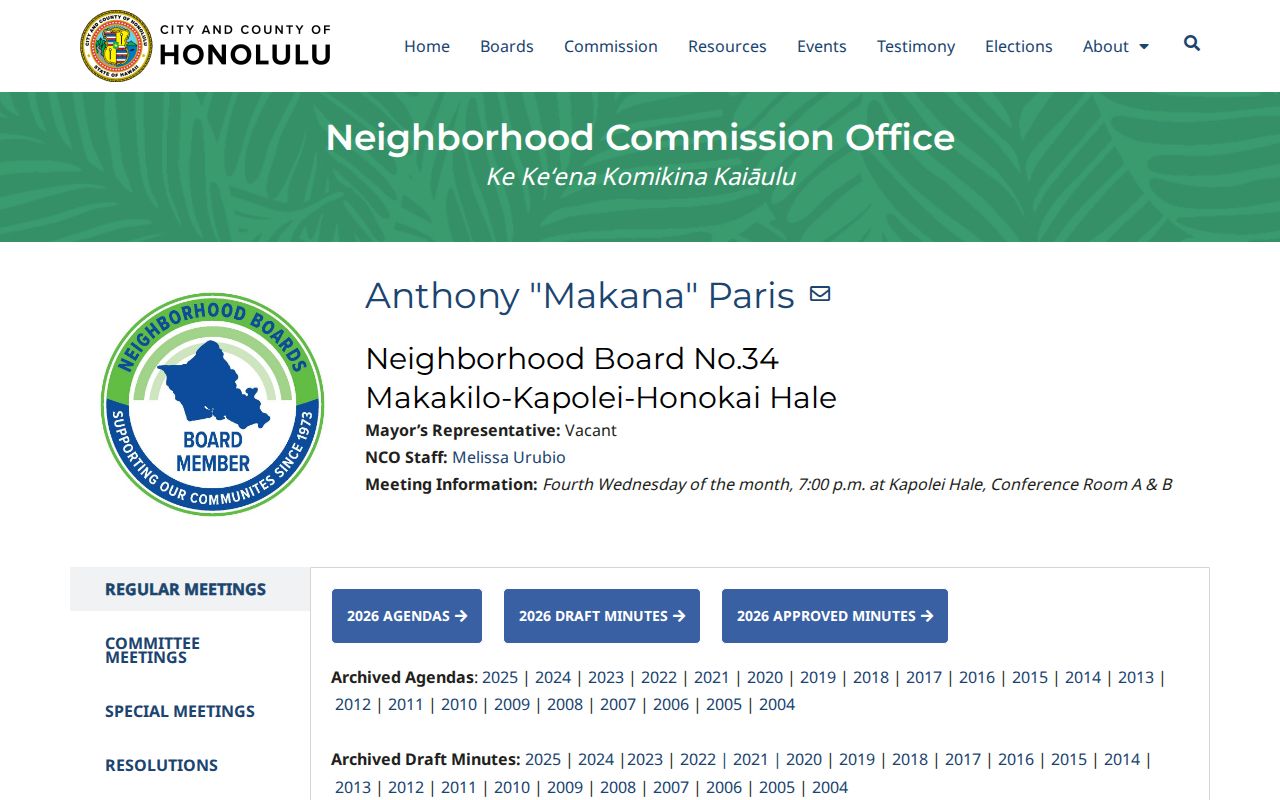
The board page helps connect Kapolei names to public meetings and neighborhood issues while keeping the person's precise record role and meeting date attached.
When Kapolei Records Stop
Some gaps are legal limits, not search failures. Public parcel files do not list every household member. OLVR does not expose a street roster. Vital certificates require eligibility. Courts withhold sealed, juvenile, and confidential material. Motor-vehicle address data is protected by federal law. Utility customer lists and private association rosters were not located as public Kapolei sources.
When an agency record should be public but is not online, use a narrow request under Hawaiʻi's Uniform Information Practices Act, HRS chapter 92F. Name the custodian, record type, subject or TMK, date range, and preferred inspection or copy format. The Office of Information Practices manual states a normal response within 10 business days, or within 20 business days when extenuating circumstances apply. Search, review, segregation, copying, and delivery fees may apply.
A closed record is the endpoint for an unauthorized requester. Contact the custodian for corrections, eligible copies, or an explanation of the access rule. Do not fill the gap with a guess or a compiled commercial profile.